Introduction
Higher education institutions generate enormous amounts of information every day. Admissions teams manage applicant data, student services handle support requests, finance teams manage payments, and academic departments track student progress. Most universities already have systems for these functions, but the information often remains distributed across multiple platforms.
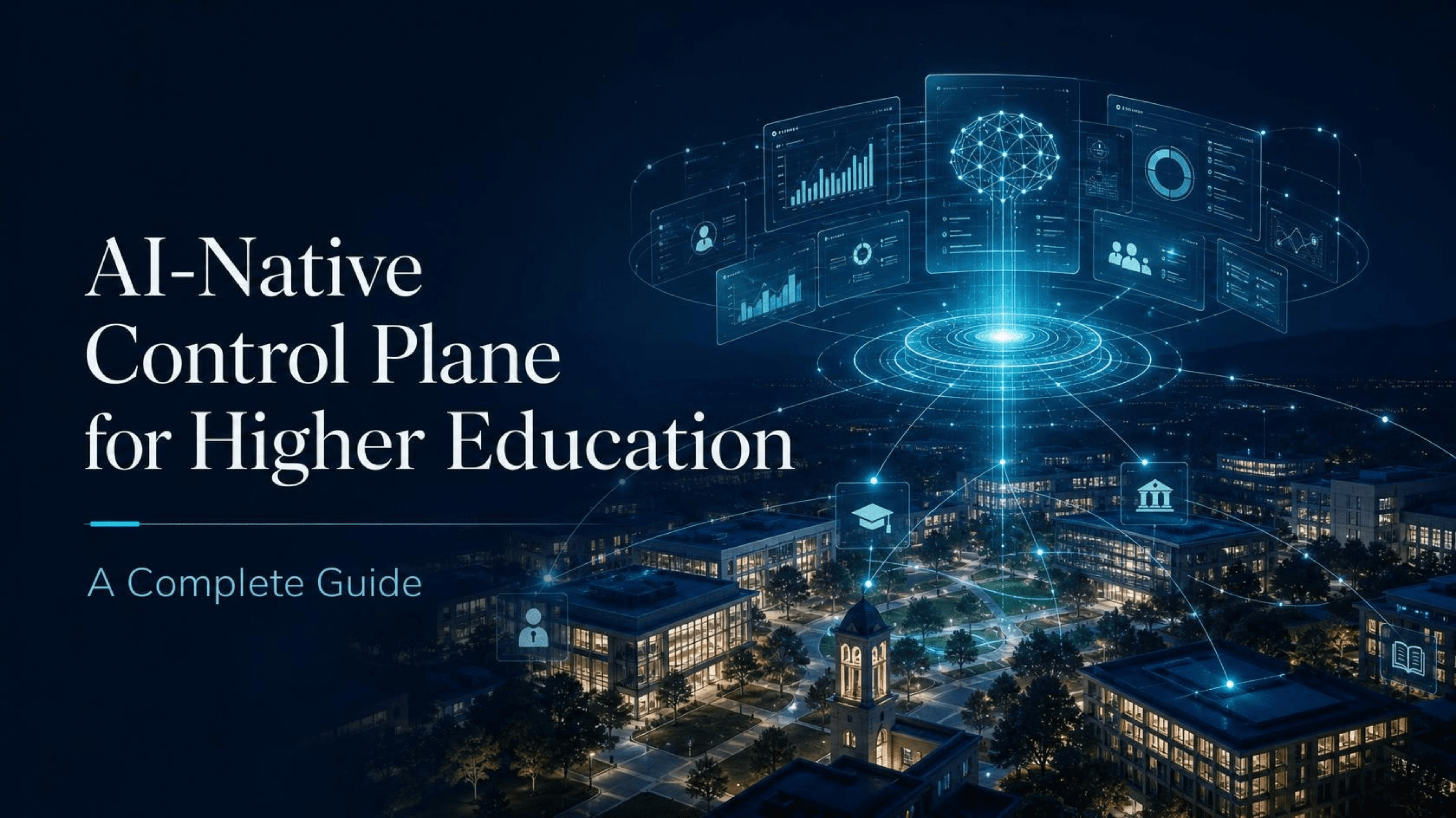
An AI-Native Control Plane for Higher Education connects these systems, understands institutional context, and coordinates intelligent actions from a central layer. Instead of using AI as an isolated chatbot or adding another dashboard, an AI-native control plane can help your institution bring data, AI, workflows, and decision-making into a more connected operating model.
Key Takeaways
- An AI-Native Control Plane connects institutional data, AI capabilities, workflows, and actions.
- It can work alongside existing SIS, CRM, LMS, ERP, and other university systems.
- The goal is to help your teams make better decisions and take timely action using relevant institutional context.
- AI agents can support repetitive tasks while human staff retain control over important decisions.
- Potential applications include admissions, enrollment, retention, student services, institutional intelligence, and summer melt prevention.
- Strong data governance, security, transparency, and human oversight are essential.
- An AI-native control plane is generally an orchestration layer, not a replacement for your core university systems.
What Is an AI-Native Control Plane?
An AI-native control plane for higher education is a technology layer that connects institutional data and systems with AI, analytics, workflows, and actions.
The term control plane comes from technology architecture, where it manages and coordinates activities across underlying systems. In higher education, the concept extends this idea to institutional operations. Your university may already use:
- Student Information Systems
- CRM platforms
- Learning Management Systems
- Enterprise Resource Planning systems
- Financial aid systems
- Admissions platforms
- Communication tools
- Data warehouses
- Student support applications
An AI-native control plane can sit across these environments, helping authorised users access relevant information, interpret context, identify opportunities or risks, and coordinate the next action.
Why Do Universities Need an AI-Native Control Plane?
Adding individual AI tools can solve specific problems, but universities may eventually face another challenge: disconnected AI applications working with different datasets, policies, and workflows.
An AI-native control plane can provide a more coordinated approach. This matters because AI adoption in higher education is already moving from experimentation toward institutional planning. EDUCAUSE's 2026 research, based on 1,960 higher education respondents surveyed in late 2025, found that 92% of respondents said their institutions had a work-related AI strategy. However, only 13% reported that their institution was measuring ROI for work-related AI tools.
This points to an important requirement — universities need to connect AI initiatives to measurable institutional outcomes. For your institution, that could mean:
- Identifying students who need support earlier.
- Reducing repetitive administrative work.
- Improving admissions follow-up.
- Coordinating student communications.
- Connecting institutional data to actionable insights.
- Measuring whether AI initiatives produce meaningful results.
How Does an AI-Native Control Plane Work?
Connect Institutional Data
The first step is connecting relevant information from systems across your institution. For example, an enrollment use case may require information from admissions, financial aid, CRM, communication, and student records.
The control plane does not necessarily replace these systems. Instead, it can provide an integration and orchestration layer through which relevant information can be accessed according to permissions and governance rules.
Understand Context
Data by itself does not explain what should happen next. An AI-native system can interpret information in context.
For example, a student with an incomplete financial aid document may require a reminder. A student with multiple unresolved issues may require intervention from a counsellor.
Apply AI and Analytics
AI models can identify patterns, generate insights, classify requests, summarise information, and support predictions or recommendations. Analytics can then help teams understand trends and measure outcomes.
EDUCAUSE's 2025 Horizon Report on Data and Analytics describes data and analytics as a critical foundation for institutional strategy, decision-making, and student success, particularly as AI increases the volume and complexity of institutional data.
Orchestrate Actions
The final step is action. If a system identifies an issue, it can trigger an appropriate workflow. This could involve sending a communication, creating a case, assigning a task, escalating an issue, or requesting human review. This is where an AI-native control plane differs from a system that only provides analytics.
Key Components of an AI-Native Control Plane
Data Integration
Your control plane needs reliable connections to relevant institutional systems. APIs, integration layers, data pipelines, and identity management can help bring authorised information together.
AI and Machine Learning
AI and machine learning models can analyse data, identify patterns, classify cases, generate recommendations, and support decision-making.
The appropriate model depends on the use case. A student FAQ may require a conversational model, while retention analysis may require statistical or machine learning methods.
AI Agents
AI agents can perform defined tasks based on instructions, available data, permissions, and workflow rules.
For example, an agent could identify students with incomplete enrollment requirements, prepare personalised reminders, and route exceptions to a staff member.
Human review remains important when actions involve sensitive information or significant student consequences.
Workflow Orchestration
Workflow orchestration determines what happens after an insight or event is identified.
For example: Student misses a required enrollment step → system detects the issue → AI determines the appropriate communication → message is sent → case is monitored → unresolved issue is escalated to staff.
Analytics and Decision Intelligence
Analytics helps your institution understand what is happening. Decision intelligence adds context around what action may be appropriate.
Together, they can help institutional leaders move from simply viewing dashboards to taking structured action based on current information.
AI-Native Control Plane vs. Traditional Higher Education Technology
Traditional higher education technology typically focuses on specific institutional functions.
- A CRM manages relationships and communications.
- An SIS manages student records.
- An LMS manages learning activities.
- An ERP supports finance and administrative processes.
An AI-Native Control Plane for Higher Education serves a different purpose. It can connect these environments and coordinate AI-supported workflows across them.
| Technology | Primary Role |
|---|---|
| SIS | Student records and academic information |
| CRM | Recruitment, engagement, and communications |
| LMS | Teaching and learning |
| ERP | Finance and administrative operations |
| Data platform | Data storage, processing, and analytics |
| AI CRM | AI-supported engagement within CRM workflows |
| AI-Native control plane | Connects data, AI, intelligence, and workflows across systems |
Use Cases of an AI-Native Control Plane in Higher Education
Enrollment Management
Your institution can connect enrollment data with student engagement and outstanding requirements to identify where additional intervention may be needed.
Student Retention
AI can help identify patterns associated with disengagement or unresolved student issues. Staff can then review the information and determine appropriate support.
Admissions
Admissions teams can use AI-supported workflows to prioritise enquiries, personalise follow-ups, answer routine questions, and identify incomplete applications.
Student Services
A connected system can route student requests to the right department and provide staff with relevant interaction history.
Institutional Intelligence
An AI-native control plane can connect information across departments to help institutional leaders understand trends and relationships that may otherwise remain hidden within separate systems.
Summer Melt Prevention
Universities can identify admitted students who have incomplete financial aid, registration, documentation, or orientation requirements and trigger timely interventions.
Benefits of an AI-Native Control Plane for Universities
A well-designed AI-Native Control Plane for Higher Education can provide several operational benefits:
- Connected data — Relevant information can be accessed across institutional systems.
- Faster decision-making — Teams can receive contextual insights without manually reviewing multiple platforms.
- Proactive intervention — Institutions can identify potential issues before they become larger problems.
- Automation — Repetitive administrative workflows can be handled with defined rules and AI assistance.
- Personalisation — Student communications can be based on individual circumstances and engagement.
- Improved visibility — Leaders can monitor institutional performance across multiple functions.
- Better scalability — AI-supported workflows can handle increasing volumes of interactions without requiring every task to be completed manually.
However, the value depends on data quality, integration, governance, and how effectively staff use the system.
AI-Native Control Plane vs. AI CRM vs. Data Platform
These technologies can overlap, but their roles are different.
- AI CRM — Primarily improves relationship management, communication, engagement, and customer or student interactions.
- Data Platform — Primarily collects, stores, processes, and analyses data from multiple sources.
- AI-Native Control Plane — Connects data, AI, decision-making, and workflows to coordinate actions across systems.
For universities, these technologies can work together. A data platform may provide the information, an AI CRM may manage engagement, and the control plane can coordinate intelligence and workflows across the wider institutional environment.
Challenges of Implementing an AI-Native Control Plane
The technology can create significant opportunities, but implementation requires careful planning.
Data Quality
AI outputs depend heavily on the quality and relevance of the data provided to the system. Inconsistent or outdated information can produce unreliable results.
Governance and Privacy
Universities handle sensitive student, financial, academic, and employee information. Access controls, data governance, privacy requirements, and auditability must be built into the architecture.
Integration Complexity
Connecting legacy systems and modern applications can require substantial technical planning.
AI Skills
Staff need sufficient understanding to use AI tools effectively and recognise their limitations.
Change Management
Technology adoption requires clear ownership, training, policies, and communication across departments.
EDUCAUSE's 2026 research identified the pace of AI development, lack of AI expertise, lack of best practices, limited time for learning, and AI-related risks among the most frequently reported challenges. It also found that 51% of respondents identified insufficient data protection as an urgent AI risk.
A practical implementation should therefore begin with clearly defined use cases, strong governance, measurable outcomes, and human oversight.
Conclusion
An AI-Native Control Plane for Higher Education represents a broader approach to institutional AI. Rather than treating AI as a collection of disconnected tools, it provides an architecture for connecting data, intelligence, AI agents, workflows, and actions.
For universities, this can support important priorities such as enrollment management, admissions, student retention, student services, institutional intelligence, and summer melt prevention.
Don't view the technology as a replacement for your SIS, CRM, LMS, or ERP. Its role is to help these systems work together more intelligently while giving your teams better context and more opportunities to act proactively.
As AI becomes increasingly embedded in institutional operations, universities will need clear governance alongside capable technology. EDUCAUSE's recent research reinforces this point: AI adoption requires strategy, infrastructure, workforce development, policies, and responsible implementation rather than technology alone.
FAQs
1. How does an AI control plane differ from an AI CRM? An AI CRM primarily focuses on managing relationships, communications, and engagement. An AI-native control plane has a broader orchestration role, connecting data, AI capabilities, workflows, and actions across multiple institutional systems.
2. What systems can an AI control plane connect? Depending on the architecture and available integrations, it can connect systems such as SIS, CRM, LMS, ERP, admissions platforms, financial aid systems, communication platforms, data warehouses, and student support applications.
3. How can AI agents support universities? AI agents can perform defined tasks such as answering routine questions, identifying incomplete processes, preparing communications, routing cases, summarising information, and triggering workflow actions. Appropriate permissions and human oversight should govern their use.
4. Can an AI-native control plane improve student retention? It can support retention efforts by connecting relevant student information, identifying potential risk signals, and triggering proactive interventions. The effectiveness depends on data quality, intervention design, staff involvement, and the specific student population.
5. How does an AI control plane support institutional intelligence? It can connect data from multiple institutional functions and apply AI and analytics to identify patterns, generate insights, and support coordinated actions. This can give decision-makers a more connected view of institutional performance.
6. Is an AI-native control plane a replacement for SIS or CRM? Generally, no. An AI-native control plane can operate alongside systems such as SIS and CRM. Its purpose is to connect information and coordinate AI-supported workflows across the existing technology environment.